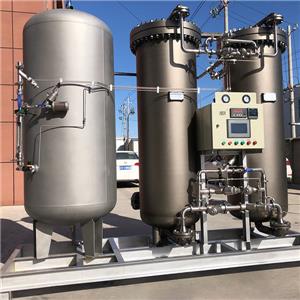

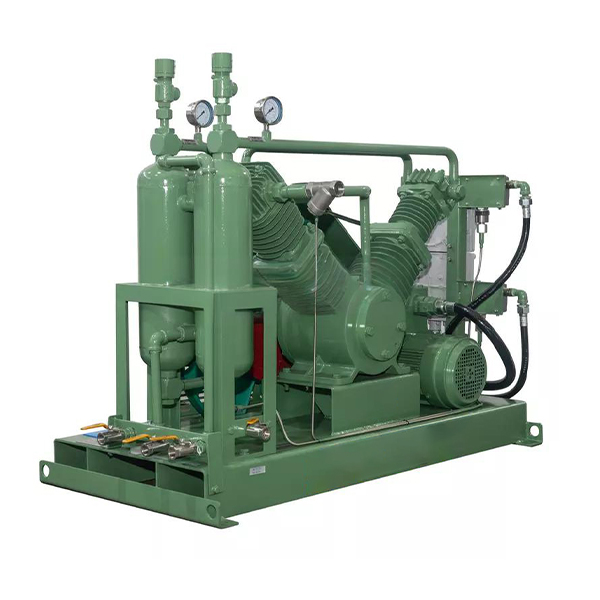
Máy nén khí hydro cần bán | Máy nén kiểu piston | Máy nén tăng áp kiểu pít-tông
Máy nén khí hydro cần bán | Máy nén kiểu piston | Máy nén tăng áp kiểu pít-tông
Ưu điểm độc đáo:
A. Thiết kế dạng mô-đun 4 hoặc 6 xi lanh;
B. Nén lên đến 5 cấp độ;
C. Bộ truyền động khớp nối từ kín khí;
D. Hệ thống làm mát bằng nước với làm mát riêng từng xi lanh/ giữa các tầng;
E. Các phiên bản chống cháy nổ theo tiêu chuẩn ISO.
Working Principle
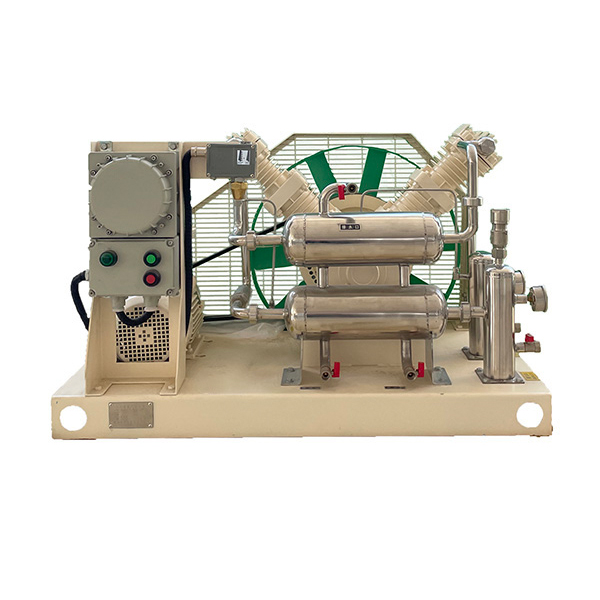
The compressor is a reciprocating, piston-type (with middle body and crosshead), single-acting, air-cooled, and fully oil-free lubrication compressor.
The compressor is composed of a main unit, a motor, a support (with buffer tank), and electrical control components. Both the main unit and the motor are placed on the support of the buffer tank. The two buffer tanks are the intake buffer and the exhaust buffer respectively, and both are equipped with gas pressure display devices, check valves, and intake and exhaust ball valves. Solenoid valves are installed in both the intake pipeline and the unloading pipeline.
When the compressor is working, the motor drives the crankshaft to produce rotational motion through V-belt transmission, and the connecting rod drives the piston to produce reciprocating motion, which changes the cylinder volume and thus the gas pressure in the cylinder. The gas under pressure is sucked into the cylinder through the intake buffer tank, intake solenoid valve, intake pipe, and intake valve, compressed into compressed gas with the required pressure through one-stage, two-stage or three-stage compression, injected into the exhaust buffer tank through the check valve and pipeline, and then enters the air storage tank through the pipeline for use.
When the intake and exhaust compression ratio is small, it is one-stage compression; when it is large, it is two-stage or three-stage compression with an intercooler.
Application Scope of the Compressor
It is used to boost the pressure of dry and particle-free oxygen, nitrogen, air, and other non-toxic and non-explosive gases.
Installation
The compressor should be placed in a dry and well-ventilated room with an ambient temperature between -20℃ and 40℃. There should be enough space around it to facilitate maintenance and service work.
Pay attention to the voltage, frequency, etc. of each electrical component, and wire according to Section 7, Electrical Schematic Diagram.
The installed intake and exhaust pipelines should avoid rigid connection.
There is no need to specially make a foundation; just level the ground and fix the foundation bolts with expansion bolts.
Compressors with pneumatic angle valve series: If the system intake pressure is < 0.7MPa, an additional air source with pressure ≥ 0.7MPa is required to open the pneumatic angle valve, and the air source should be connected to the reserved interface of the two-position three-way solenoid valve; if the system intake pressure is ≥ 0.7MPa, no additional air source is needed.
Installation and Use
After the compressor is installed and confirmed to meet the requirements, it can be commissioned.
Before commissioning, check: whether the bolts and nuts are loose. Press the middle part of the V-belt with the index finger to check the V-belt; it is normal if the V-belt can sag about 10mm.
Khởi động ngay, nối ống hút, mở van bi hút và xả, rồi bật nguồn. Khi áp suất hút đạt đến giới hạn áp suất hút trên đã cài đặt, máy nén sẽ khởi động. Kiểm tra xem chiều quay có trùng với mũi tên chỉ trên máy nén hay không.
Nếu các bước kiểm tra trên đều bình thường, hãy cho máy nén hoạt động ở tải thấp trong hơn 10 phút.
Vận hành thử: Đối với máy nén không có van góc khí nén, vận hành theo mục 2.4.1; đối với máy nén có van góc khí nén, vận hành theo mục 2.4.2.
Hướng dẫn vận hành bổ sung
Đóng van bi xả; áp suất khí bên trong bình chứa khí sẽ tăng lên. Khi áp suất khí thải tăng đến giới hạn áp suất trên đã cài đặt, bộ điều khiển áp suất thông minh sẽ hoạt động, van góc khí nén đóng lại và máy nén chuyển sang trạng thái chạy không tải. Sau khi duy trì trạng thái này trong khoảng 5 phút (thời gian này có thể điều chỉnh), nếu áp suất trong bình đệm khí thải vẫn cao hơn giới hạn áp suất khí thải dưới đã cài đặt, rơle trễ thời gian sẽ hoạt động để ngắt nguồn điện của mạch tiếp điểm, động cơ ngừng quay, áp suất bên trong bình chứa khí sẽ không tăng nữa và van điện từ xả mở ra để kết nối buồng xả và đường ống với buồng hút và đường ống. Điều này nhằm mục đích khởi động không tải khi khởi động lại máy nén.
Mở van bi xả; áp suất khí bên trong bình chứa khí sẽ giảm. Khi áp suất xả giảm xuống đến giới hạn áp suất xả dưới đã cài đặt và áp suất hút đạt đến giới hạn áp suất hút trên đã cài đặt cùng lúc, bộ điều khiển áp suất sẽ được bật, máy nén khởi động lại, van xả đóng, van điện từ hút mở và áp suất tiếp tục tăng. Lúc này, máy nén hoạt động bình thường.
Nếu các bước kiểm tra trên đều bình thường, máy nén có thể bắt đầu hoạt động. Lưu ý trong quá trình vận hành: Tuyệt đối không được đặt áp suất khí thải vượt quá giá trị áp suất định mức tối đa; nếu không, sẽ gây ra sự cố. Khi công việc hoàn tất hoặc mất điện, cần phải tắt nguồn điện.
※ Nếu áp suất đầu vào không được kiểm soát, máy nén chỉ được điều khiển bởi các giới hạn trên và dưới đã được thiết lập của áp suất đầu ra.